
Blog
July 21, 2026
The way we work is no longer tied to a single office - or even a single time zone. Most companies now operate in a hybrid work environment, where remote and in-office work constantly overlap. That flexibility sounds simple, but in practice it creates a new problem: keeping teams aligned while everything is distributed.
Communication, collaboration, and productivity no longer depend on where people sit, but on how well systems are designed to connect them. This is where modern hybrid work tools come in: a stack of software that powers everything from project management to real-time collaboration across teams.
Hybrid models combine remote and in-person work, but in practice it’s less about where people work and more about how tasks coordinated across different environments. Schedules are managed through calendars, meetings are carried out across time zones, and tools are used to handle everything from document sharing to office logistics.
While this setup creates flexibility, it also introduces a dependency on various tools and systems in order for team members to stay in sync.

Team need to be aware of potential friction points that can impact productivity and coordination.
The most common issues include:
To build a successful hybrid work environment, it is helpful to think of tools not as isolated applications, but as part of a connected system.
This system can be broken down into four key layers:
1. The planning layer: where work is defined. It ensures tasks are clearly structured, ownership is assigned, and expectations are set before execution begins.
2. The communication layer: how teams stay aligned. It covers both real-time and asynchronous interaction, making sure decisions and updates move between people without constant meetings.
3. The collaboration layer: defines how work actually takes place. It enables people to create and edit shared outputs together, regardless of where they are working from.
4. The operations layer: supports everything behind the scenes. It handles coordination between systems, reduces manual effort, and ensures security and reliability across the work environment.
Modern hybrid workplaces rely on effective communication to keep teams connected across locations and time zones. Platforms like Slack and Microsoft Teams support both instant messaging and ongoing conversations that help teams stay aligned.
Moreover, Microsoft Team, Zoom, Google Meet enable video calls when topics need to be addressed in depth.
Project management tools such as Asana, Jira, Trello, and Monday.com help teams track progress, manage workloads, and ensure deadlines are met. This provides better visibility into tasks and helps remote workers coordinate more efficiently.
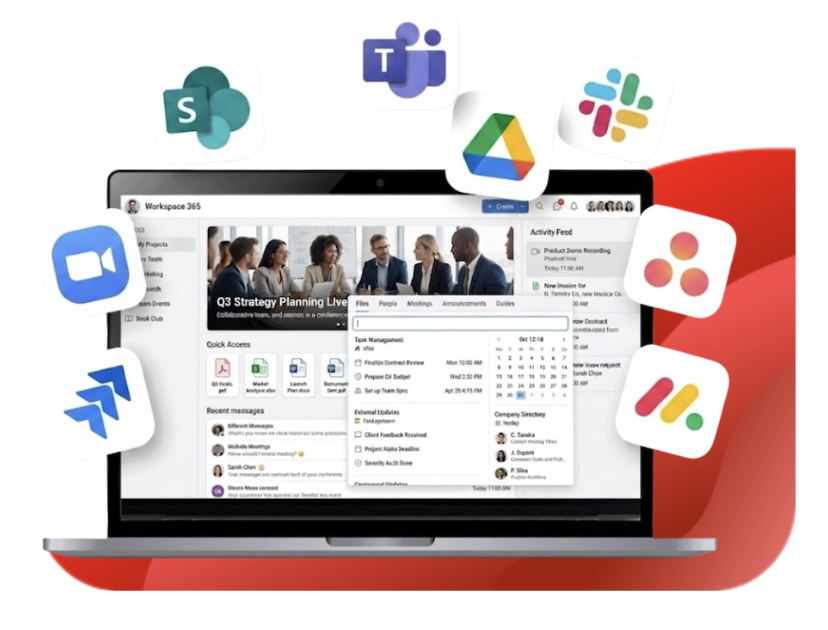
Cloud-based services like Google Workspace and Microsoft SharePoint allow employees to access and work together on documents, spreadsheets, and presentations in real time. This reduces reliance on back-and-forth email/ message threads, ensuring everyone is working from a single, up-to-date source of information and improving employee productivity.
Scheduling systems like Google Calendar or Microsoft Outlook help teams coordinate availability across remote and in-office schedules. For physical spaces, tools like Envoy can be used to manage meeting room booking and desk reservations, making it easier for employees to plan office days and avoid scheduling conflicts.
In hybrid environments, work doesn’t live in a single tool, but moves through a sequence of systems. A task might be planned in one platform, discussed in another, and completed somewhere else.
Integration is what connects these steps: it is the way information travels between tools so that work can continue without losing context or needing to be manually rebuilt at each stage. In practice, this means ensuring that updates, decisions, and outputs are carried forward as part of the workflow itself, rather than being reintroduced in every system. The focus is maintaining continuity as work moves across tools, not on how many tools are being used.
AI assistants can sit on top of this flow by helping summarize what has happened across systems and reducing the effort needed to keep track of progress.
Instead of focusing on hours worked, organizations look at delivery speed, consistency of output, and whether teams and whether teams are meeting their commitments .
Within a digital workplace, performance data is often drawn from project systems that show how work is progressing over time. These insights help identify delays, uneven workload distribution, and areas where coordination between remote employees and on-site ones may need improvement.
Beyond delivery metrics, the employee experience also plays an important role in assessing success. If processes are too fragmented or coordination is overly complex, it often shows up in slower decision-making and reduced engagement, even if output remains steady.
In effective hybrid setups, productivity is reflected not just in what gets delivered, but in whether distributed teams can have a seamless collaboration.
Hybrid work succeeds when tools, workflows, and systems are designed to work together rather than in isolation. From communication and collaboration to planning and execution, productivity depends on how seamlessly information flows across the entire organization.
At Roca Mindhub, we help companies design and build the systems that make hybrid work function at scale: supporting remote work, improving process automation, ensuring data security, and enabling more effective collaboration across teams.


445 Apple Creek Blvd, Suite 220, Markham, Ontario
Follow Us:


Services
Roca
Contact
+1 647 476 7680
info@rocanetworks.com
rocamindhub.com
